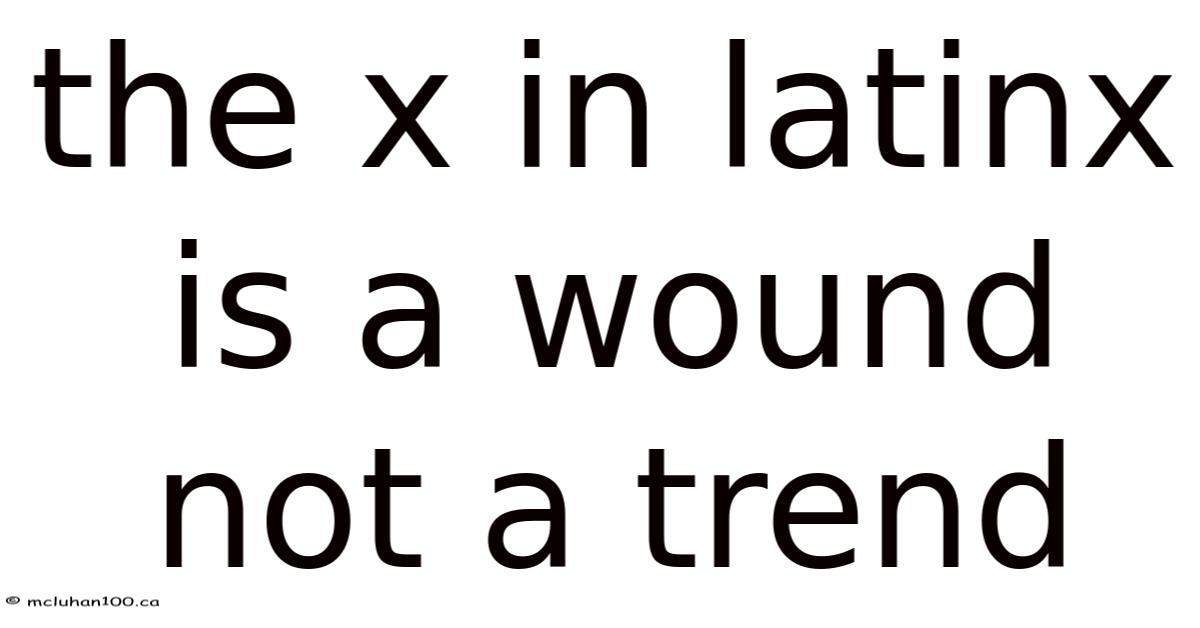
Why That X in Latinx Feels Like a Wound, Not a Trend
You saw it on the survey. But here's what most people miss: that x in latinx isn't some linguistic fad or political flex. Maybe your cousin changed their Instagram bio and you just rolled your eyes. Think about it: you saw it in the meeting. It's a wound that refuses to heal because we keep reopening it Most people skip this — try not to..
The x sits there in the middle of latinx like a question mark that decided to become a period. In real terms, it doesn't roll off the tongue the same way español or española does. Worth adding: it creates a little hiccup in pronunciation that makes native speakers feel something — discomfort, confusion, sometimes anger. And yeah, that's kind of the point.
But before we get lost in the semantics, let's actually sit with what this little letter represents. On top of that, you might even be one of the people wearing the term like a badge or rejecting it like a bad habit. Because if you're reading this, you probably already know it's complicated. Either way, the x is doing work — and not the kind most people think No workaround needed..
What Is Latinx, Really?
Let's step back from the politics and just talk about language. The x in latinx emerged from Spanish-speaking communities in the United States, particularly among younger activists and academics in the 2010s. The goal was straightforward: create a gender-neutral alternative to latino or latina Which is the point..
But here's the thing that gets lost in translation — or maybe it's the thing that gets translated wrong on purpose. Because of that, it's about erasure. The x isn't just about gender. It's about what happens when you try to fit a continent's worth of diverse identities into a binary box that was never yours to begin Most people skip this — try not to. Which is the point..
In Spanish, masculine and feminine forms aren't just grammatical choices. Think about it: when you say "latino," you're not just using the masculine plural — you're invoking a system that privileges male identity as the default. Practically speaking, same with "latina. They're social ones. " The x attempts to break that cycle, but it does so by introducing something completely foreign to the language And that's really what it comes down to..
That's where the wound comes in.
The Linguistic Chasm
Try saying "latinx" out loud. Go ahead. I'll wait.
Did you say "lah-TEE-nex"? "LAH-tee-nex"? Or did you stumble like most people do, caught between honoring the Spanish pronunciation and accommodating the English phonetic expectations?
Native Spanish speakers often pronounce it closer to "lah-TEE-nesh" or just avoid it entirely. And that avoidance? That's part of the wound too.
The x doesn't belong in Spanish the way it does in English. It's a transplant, a graft, something that has to prove itself every time it's spoken. And when you have to prove yourself every time, you're not part of the conversation — you're an interruption Simple as that..
Some disagree here. Fair enough.
Why People Actually Care (Beyond the Buzzwords)
Here's where it gets real. You can read all the think pieces and hear all the talking points, but eventually you have to sit with the fact that this isn't about vocabulary — it's about belonging Still holds up..
For many Latino and Latina people, especially those who grew up speaking Spanish at home, latinx feels like someone else's solution to a problem they didn't create. It's the academic elite imposing a fix on a community that's been navigating its own complexities for generations That's the whole idea..
And that's not nothing.
I've watched family gatherings turn tense over this. I've heard grandparents ask why their grandkids are trying to "change" their identity. I've seen cousins unfollow cousins on social media. These aren't abstract philosophical debates — they're about who gets to define who we are Not complicated — just consistent..
The x becomes a symbol of something larger: the tension between assimilation and authenticity, between being seen and being reduced to a label. It's not that people don't want to be included or respected — they're just tired of having solutions imposed from the outside.
The Generational Divide
Younger activists see latinx as necessary progress. Because of that, they've grown up in spaces where gender identity is more visible, where non-binary experiences are part of the conversation. To them, using latinx is solidarity.
Older generations see it as erasure. They've lived through immigration struggles, through being called "illegal," through having their language and culture dismissed. Now someone's asking them to adopt a term that makes them feel linguistically inadequate?
That's not resistance. That's trauma Easy to understand, harder to ignore..
And honestly, both perspectives are valid. Both are rooted in real experiences of marginalization. The problem isn't that one side is right and the other is wrong — it's that we've turned a linguistic evolution into a battleground It's one of those things that adds up..
The Wound That Won't Close
Here's what most people miss when they reduce this to "language evolution" or "cancel culture": the x is a wound that keeps reopening because we refuse to listen to the people bleeding.
Every time someone says "latinx" without understanding why it matters to some and hurts others, they're pouring salt in the wound. Worth adding: every time someone dismisses concerns as "resistance to change," they're adding insult to injury. Every time we treat this like a trend rather than a symptom of deeper issues, we're choosing to ignore the pain That alone is useful..
The wound isn't the x itself. The wound is the feeling of being unheard. The wound is the sense that your experience of identity and language doesn't matter unless it fits someone else's framework. The wound is knowing that you're caught between worlds, never fully belonging to either No workaround needed..
And that's before we even get to the fact that many people who might benefit from a gender-neutral term don't actually use latinx — or use it reluctantly — because they don't feel it represents them.
Who Gets to Decide?
This is the question that keeps me up at night (okay, maybe not literally, but you get the point). Because of that, who gets to decide what language serves us? Is it academics? Because of that, is it activists? Is it the people most affected?
In theory, the answer seems clear. In practice, it's a mess.
I've talked to trans Latinos who feel seen by latinx. I've talked to cis Latinos who feel erased by it. I've talked to Spanish speakers who think it's beautiful that their community is finding new ways to include everyone. And I've talked to Spanish speakers who think it's a linguistic atrocity that should die quickly.
None of these perspectives are wrong. But none of them are irrelevant. The challenge is that we've made this into a popularity contest rather than a conversation.
What Most People Get Wrong
The biggest mistake people make is treating latinx like it's either a solution or a problem. It's not either/or — it's both/and.
Some people treat latinx like a magic bullet that will solve all inclusion issues overnight. In practice, they deploy it without thinking, without understanding the history, without considering impact. And that's when it becomes a trend rather than a tool.
Others treat it like a threat that must be stopped at all costs. Which means they reject it out of hand, sometimes with hostility, sometimes with dismissal. And that's when it becomes a wound rather than a word.
The truth is messier than both positions allow.
The Trendification Trap
Here's what kills me about how latinx gets treated: it becomes a checkbox. "Oh, we need to be inclusive, let's use latinx." Suddenly it's corporate diversity training language rather than a lived reality Simple, but easy to overlook..
I've seen job postings that list "latinx-friendly" as a perk. In real terms, i've seen event planners who ask speakers to use latinx because it sounds progressive. I've seen universities that require latinx in all communications without consulting their actual Latino and Latina students.
People argue about this. Here's where I land on it The details matter here..
This is trendification at its worst — taking something deeply personal and making it performative.
And when latinx becomes a trend, it ceases to be meaningful. It becomes just another way to signal virtue without doing the hard work of actually listening to and centering the voices that matter most Which is the point..
What Actually Works
So what does it look like to handle this with care? To approach latinx without reopening wounds?
First, stop treating it like a monolith. Because of that, " There are dozens of countries, hundreds of languages, countless cultural variations. In practice, there's no single "Latino community" or "Latina experience. The x might resonate with some and not others — and that's okay It's one of those things that adds up..
Second, listen more than you speak. If you're not Latino or
If you're not Latino, your job isn't to dictate the terminology for the community; it's to create space where the community can define itself. In real terms, this means moving away from the "correctness" police and moving toward active listening. Ask them why. Day to day, when someone tells you a term makes them feel excluded, don't respond with a lecture on gender theory. Respond with curiosity. Listen to the history behind their discomfort.
Third, prioritize intent over aesthetics. Inclusion isn't about the specific letters used at the end of a word; it's about whether the person behind the word feels safe, respected, and heard. In real terms, you can use "Latino" and still be incredibly inclusive through your actions, your hiring practices, and your advocacy. Conversely, you can use "Latinx" every single day and still be exclusionary if you aren't actually doing the work to support the people within the community.
Honestly, this part trips people up more than it should And that's really what it comes down to..
Moving Beyond the Binary
The debate over "Latinx" is often framed as a battle between tradition and progress, but that is a false dichotomy. And real progress doesn't require the destruction of tradition; it requires the evolution of it. Language has always been a living, breathing entity. It shifts as our understanding of the world shifts.
We need to stop treating this as a linguistic war and start treating it as a communal evolution. In practice, we are currently in the "awkward teenage years" of this linguistic shift. It’s messy, it’s loud, and everyone is tripping over themselves. But this friction is actually a sign of life. It means we are finally talking about identity in ways we weren't allowed to talk about twenty years ago.
Conclusion
At the end of the day, the "x" isn't the goal. The goal is the person And that's really what it comes down to..
If we spend all our energy fighting over the spelling of our identity, we will lose sight of the people who are actually living it. We will become so obsessed with the vocabulary of inclusion that we forget the actual practice of it.
Whether you prefer Latino, Latina, Latinx, or simply "Latine," the most important thing is that we don't let the debate become a barrier to the connection. Worth adding: the goal isn't to find the "perfect" word that satisfies everyone—because, as we've seen, that word doesn't exist. The goal is to find a way to see one another, honor our diverse histories, and check that no one is left behind in the pursuit of belonging.
